
Residential & commercial garage doors
Straight Tracks, Smoother Travel
A bent rail, shifted bracket, widened channel, or roller rubbing one side can point to garage door track replacement in Fairfax, VA when the door’s travel path loses its correct shape.
Minor track movement may sometimes come from loose or shifted mounting hardware rather than permanent rail damage. Replacement becomes more relevant when the track is sharply bent, twisted, crushed, separated, or unable to maintain suitable roller clearance through the door’s normal travel path.
A sectional garage door normally travels through vertical tracks beside the opening, curved transition sections near the top, and horizontal tracks extending into the garage. These rail sections must form a continuous path so the rollers can guide each door section from the closed position into the overhead position without abrupt changes in direction.
Track position matters just as much as track shape. The rails require enough clearance for roller movement without allowing uncontrolled side travel. A general garage door repair service can identify an unknown operating fault, while track-specific work focuses on rail geometry, mounting points, brackets, joints, and the physical path followed by the rollers.
Track damage is not limited to one obvious bend. A rail edge can spread outward after impact, a vertical section can twist away from the jamb, or a transition area can become distorted enough to pinch the roller as it changes direction. Even a relatively short damaged area can interrupt movement through the rest of the path.
Mounting problems create another type of track failure. Loose jamb brackets, shifted flag brackets, damaged fasteners, or weak overhead supports can move an otherwise usable rail out of position. The metal may still look straight, but the path itself may no longer line up with the door and roller system.
A garage door track doesn’t have to be visibly bent to cause problems. Loose brackets or shifted mounting points can move the rail out of alignment, causing rollers to rub, catch, or struggle as the door opens and closes. Correcting the track’s position may resolve the issue without replacing the rail.
However, a track that is bent, twisted, or unable to maintain proper alignment may need replacement. During garage door track replacement in Fairfax, VA, Metro Garage Doors examines the rail and its supporting hardware to determine whether the problem requires new track sections or repairs to the existing mounting components.
Step 1
Vertical rail position, track spacing, curved transitions, horizontal alignment, joints, and bracket locations are checked against the door’s actual movement.
Step 2
Bent edges, twists, widened channels, damaged mounting points, and rail sections that no longer maintain usable roller clearance are identified.
Step 3
Damaged track sections are replaced and mounting points positioned so the vertical, curved, and horizontal rails create continuous guided travel.
Step 4
The door is moved through its full path while roller clearance, rail stability, section position, and transition through each track area are checked.
Damage may be limited to one vertical section, a curved transition, a horizontal rail, or the hardware holding the track in position. Replacing more rail than necessary does not make the repair more effective. The important question is which part of the path has actually lost its shape, position, or structural support.
Each rail section is evaluated separately to determine where deformation, movement, separation, or loss of support actually begins.
Roller clearance is checked throughout the path because a track can appear straight while still sitting too close to the door.
Jamb brackets, flag brackets, fasteners, joints, and overhead supports are reviewed because track position depends on stable mounting.
The completed rail system should guide rollers continuously through vertical, curved, and horizontal travel without abrupt alignment changes or pinch points.
Minor deformation may sometimes be correctable when the rail remains structurally sound and can return to the proper position without weakening the track profile. A sharply crushed, twisted, split, or repeatedly distorted section may be a stronger candidate for replacement. The mounting hardware should also be checked before deciding.
Replacement becomes more likely when the rail cannot maintain its original channel shape, has severe twisting, damaged joints, cracked metal, repeated roller displacement, or compromised mounting points. The decision should consider both the visible damage and whether correct roller clearance can still be restored.
Garage door rollers require some operating clearance and are not normally clamped tightly inside the rail. Excessive space, however, can result from a spread track opening, incorrect track position, worn rollers, hinge movement, or alignment problems. The roller and rail should be assessed together.
Side rubbing can develop when track spacing changes, a bracket shifts, the rail bends inward, a hinge changes roller position, or the door itself moves out of alignment. The contact point helps determine whether the rail needs repositioning, replacement, or work on another connected component.
Not automatically. Damage can be isolated to one vertical or horizontal section while the opposite rail remains correctly positioned and structurally sound. Both sides should still be compared for spacing, support, alignment, and roller clearance before deciding how much of the track system actually needs replacement.
Metro Garage Doors checks track condition in relation to the rollers, hinges, brackets, and door position rather than treating every visible rail issue as an isolated piece of bent metal. A damaged track can change the route every roller must follow. Call (703) 944-0855 if a rail is bent, twisted, separated, pulled from its mounting point, or no longer holding the door in its normal travel position.
We’re available 24/7 for your assistance!
Prefer to talk?
Not every door that rubs, binds, or leaves its normal path needs new rails. Metro Garage Doors also checks the components that determine how the door enters and moves through the track before recommending the next repair.

If the rail is correctly positioned but the wheel binds or wobbles inside it, garage door roller replacement may address the actual movement problem.
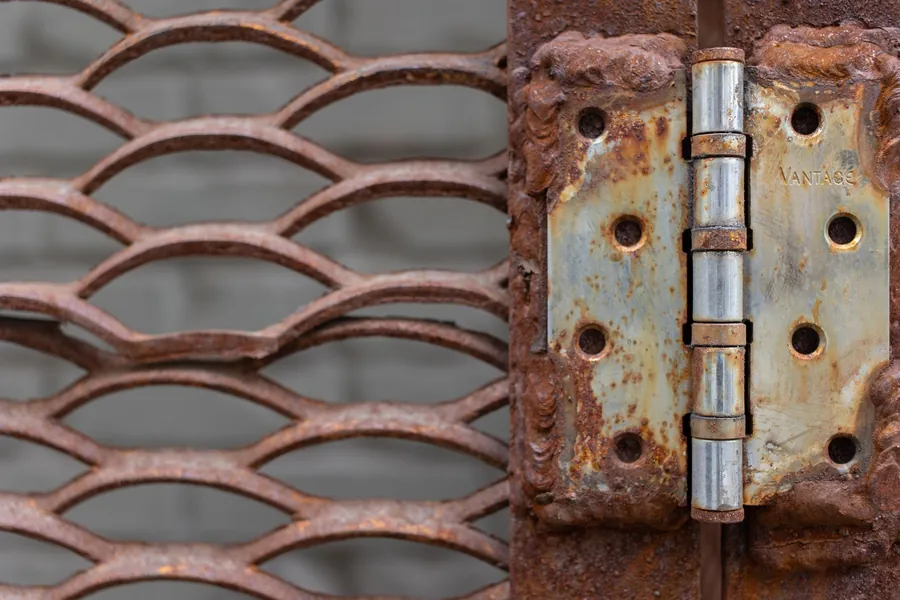
If a roller stem enters the track at an incorrect angle because its section connection is damaged, garage door hinge replacement may be needed.

If one side is being pulled differently even though the rails remain straight, garage door cable replacement may address the lifting imbalance.
When track, roller, hinge, and lifting symptoms overlap, garage door repair can identify which system is actually disrupting normal travel.