
Residential & commercial garage doors
Swing Into Secure Access
A driveway gate needs more than enough space to open. With swing gate installation in Fairfax, VA, we plan for leaf movement, hinge support, and secure closing around your entrance.
A single swing gate uses one hinged leaf to cover the entrance, while a double swing gate divides the opening between two leaves. The better configuration depends on driveway width, available opening space, support-post positions, and vehicle movement. Automatic systems also require compatible operators and suitable safety equipment.
A single-leaf driveway gate places the entire entrance width on one moving assembly. Its hinges and supporting post must carry that leaf’s weight and the forces created during movement. The available opening arc determines whether the gate clears parked vehicles, nearby structures, and the driveway surface when fully opened.
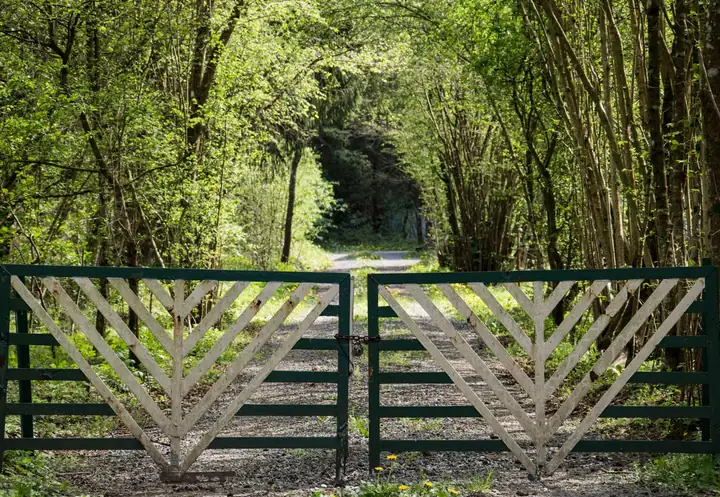
Double-leaf gates divide the opening between two hinged panels. Each leaf needs its own supports, opening clearance, and defined closing position. For automated systems, the operators must coordinate movement where the design requires a closing sequence. The meeting point between the leaves also needs suitable stops and latching or locking arrangements.
A driveway gate occupies usable space while opening. Vehicles approaching from the street need a suitable stopping position outside the moving leaves. Cars parked inside the property must also remain clear of the opening arc. These distances influence leaf dimensions and whether inward or outward movement is appropriate.
In a Fair Lakes driveway with limited space between the entrance and the parking area, a long single gate leaf might interfere with a parked vehicle. Planning swing gate installation in Fairfax, VA around the full opening arc helps identify clearance restrictions before the gate’s dimensions and mounting positions are finalized.
Powered swing gates need an operator that matches the gate’s size, weight, hinge arrangement, and opening requirements. Linear actuators and articulated-arm operators use different mounting geometries. The hinge offset and available bracket positions affect how operating force reaches the moving leaf throughout its travel, not merely at the closed position.
For new powered entrances, Metro Garage Doors reviews the proposed gate arrangement alongside operator compatibility and access-control requirements. A mounting position unsuitable for the selected actuator creates operating problems even with a properly supported gate. Manual configurations have different hardware requirements, relying on suitable hinges, positive stops, and secure latching rather than powered movement.
Step 1
We measure the entrance, identify vehicle clearance requirements, and establish suitable opening directions and leaf dimensions for the property.
Step 2
Gate-post locations, mounting surfaces, foundations, and hinge positions are prepared according to the selected gate’s structural requirements.
Step 3
The gate leaves are hung, aligned, and checked against ground clearance, receiving hardware, mechanical stops, and their full opening arcs.
Step 4
For powered installations, compatible operators, access controls, travel settings, and required safety devices are installed and tested for intended operation.
For single- and double-leaf entrances, swing gate installation in Fairfax, VA depends on correctly supported movement and a consistent closing position. The gate must open without striking nearby structures and return to its receiving hardware without excessive force. Automated systems also require suitable travel control and protection against hazardous movement.
Hinge spacing, post support, and mounting positions must accommodate the moving leaf's weight and maintain its alignment throughout the opening arc.
On double-leaf gates, the two closing edges must meet at their intended position without overlapping incorrectly or forcing one leaf against another.
Actuator brackets and connection points need to match the operator's specified mounting geometry and the gate's required opening angle.
Automatic systems need appropriate entrapment protection around hazardous hinge, closing-edge, and adjacent structure areas, with compatible monitored safety devices.
Outward-opening gates require enough space to complete their swing without obstructing public sidewalks, streets, or other restricted areas. The driveway layout, property boundary, local requirements, and selected gate configuration determine whether outward movement is suitable. A gate must not extend into a public right-of-way where that encroachment is prohibited.
Brick columns require assessment before supporting a new swing gate or actuator. Their structural condition, internal reinforcement, foundations, and available mounting points determine whether the proposed hardware is suitable. Surface-mounted brackets alone do not establish adequate support. The column must withstand the gate’s loading and the forces produced during powered movement.
Automatic vehicular gates use appropriate entrapment protection, which includes monitored photo-eyes, sensing edges, or other compatible devices according to the operator and identified hazards. These devices respond to specified obstructions or contact conditions. They do not replace careful gate placement, suitable vehicle detection where needed, or safe operating practices.
A manually operated swing gate does not require an electrical connection for movement. Automatic systems need a suitable power source, which may involve a wired supply or a manufacturer-approved solar and battery arrangement. The operator’s energy requirements, gate usage, sunlight conditions, and backup capacity determine whether a particular power configuration is practical.
Pricing depends on gate dimensions, materials, single- or double-leaf construction, and the required post and foundation work. Automatic swing gate installation also involves compatible operators, electrical provisions, access controls, and safety equipment. Ground conditions, gate weight, and hardware specifications affect the work required before an installation estimate is prepared.
A single-leaf and a double-leaf entrance place different demands on your driveway. Metro Garage Doors helps assess gate movement and installation requirements. Call (703) 944-0855 to discuss your property.
We’re available 24/7 for your assistance!
Prefer to talk?

Existing driveway gates with damaged hinges, faulty actuators, or unreliable closing require swing gate repair rather than another installation.

Pedestrian entrances use door frames, hinges, closers, and locks instead of driveway gate posts and actuators. See our swing door and gate services.

Existing manual gates require suitable hinges, closing stops, catches, and supporting posts to maintain movement and secure the entrance.
Electric swing gates depend on compatible actuators, opening controls, safety equipment, and operator settings matched to the installed gate assembly.